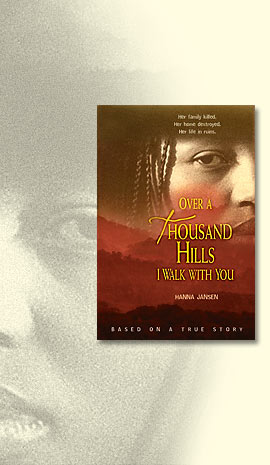
Over a Thousand Hills I Walk with You follows a young girl, Jeanne, through the days before and journey after the Rwandan genocide of 1994 – one of the greatest horrors the world has seen. Nearly 1 million people were killed in 100 days, solely because of their Tutsi ethnicity. With tremendous courage, wits and luck, Jeanne managed to survive, but lost her entire family to the genocide. Author Hanna Jansen wrote this poignant book based on the true experiences of her adopted daughter Jeanne. Hanna, her husband and Jeanne currently live in Siegburg, Germany with the Jansen's nine other children, most of whom are war orphants. Translator Elizabeth D. Crawford, winner of the 1998 Mildred L. Batchelder Award, has carefully retained the authentic voice of the original German text. Hauntingly unforgattable, the story presents a true tribute to the human spirit and ist amazing capacity to heal. Press At its heart the Rwandan tragedy was profoundly personal. Personal for every man, woman and child who experienced the terror, who lost those they loved. This novel captures with great poignancy the terrible cost to the youngest and most vulnerable. This is an extraordinary and devastating book. It needs to be on the school curriculum, like the Diary of Anne Frank, or All Quiet on the Western Front. I will never forget it. At times I couldn't bear to carry on reading, I was so deeply affected by it. A powerful testimony of the genocide in Rwanda Excerpt What kind of a war is it, Jeanne wondered, when they hang out their wash while other people are killed for no reason? What had she and her family, what had their friends done that they deserved death? International Editions |
 |
Germany: Hanna Jansen |
 |
UK: Hanna Jansen |
 |
France: Hanna Jansen |
 |
France: Hanna Jansen |
 |
Italy: Hanna Jansen |
 |
Netherlands: Hanna Jansen |
Review Publishers Weekly Reviewed April 2006 Reviewed March 2006 Novel of the Rwandan Genocide has personal roots In April 1996, Hanna and Reinhold Jansen of Siegburg, Germany, received a phone call from the African mission in Cologne, through which the couple had adopted orphaned Rwandan twins the prior year. The misson wanted to know if the Jansens would be willing to take in yet another Rwandan orphan. They agreed, opening their home and hearts to Jeanne d'Arc Umubyeyi, who was the sole member of her Tutsi family to survive the horrific 1994 genocide in her country. She had traveled to Germany to live with her aunt, who contacted the African mission when she realized that she was not able to take care of her niece. Ten-year-old Jeanne quickly warmed to her new family, which included 12 other children, most of whom were also war orphans. As the girl learned to speak German, she began to share with her adoptive mother the story of her past, which included witnessing the murders of her mother and brother and the massacre of many others. Hanna Jansen went on to shape a novel based on Jeanne's traumatic, often unthinkable experiences. First published in Germany, Over a Thousand Hills I Walk with You will be released here next month by Carolrhoda Books, in a translation by Elizabeth D. Crawford. Asked about her inspiration for relaying her daughter's saga in a novel, Jansen explains that she and Jeanne "had been discussing it together for four years. The older she became, the more we tried to see her detailed memories in the whole context of the genocide and to draw on other sources, in order to understand the connections better. The genocide was continually ignored by Western media and Western policy, not only while it was happening but also for a long time afterward. Many people in this country did not even know where Rwanda was. This gave me the idea of writing a book in which the reader could develop a close emotional connection to a child who was subjected to such a dreadful experience. I also wanted to correct the picture of an 'uncivilized Africa,' so that no one could get the idea that the fearful crimes were committed by so-called 'savages.' " On a more subjective note, writing Jeanne's story, Jansen reflects, "meant for me personally coping with the terrible events that, through the children, also have become a part of our personal history. I wanted to draw Jeanne's parents and siblings out of the void of namelessness so that they could be seen as persons who were known and loved, proxies for the other millions of dead. It was also Jeanne's wish to give the victims a face and a voice. In addition, I wanted to tell something about hope and the strength to live." For Jeanne, the mother-daughter conversations that provided the frame for Over a Thousand Hills were, Jansen says, "labors of memory and grief. They helped her to take leave and to open herself to her new life." Noting that her daughter's keen memory made her "a very reliable witness," Jansen remarks that recalling even the positive aspects of her past was painful for Jeanne: "It was hard for her to return to the good memories of her family that, until then, she had split off from herself. To feel what she had lost called up enormous grief in her, which I had to cushion. Sometimes I could only hold her tight, not knowing how to comfort her." Tackling the task of fusing fact and fiction, the author discovered that she and Jeanne complemented each other in quite a remarkable way. As Jansen set out to "unfurl my own powers of imagination and invent truthfully," she repeatedly came uncannily close to the reality of her daughter's experiences. When Jeanne read finished chapters to give her mother feedback, Jansen realized that her intuitions "were sometimes so close to the truth that I would invent something Jeanne had in fact experienced. Some days she would come to me with the manuscript and say, 'Mama, today you remembered something that I had forgotten.' " The importance of remembering is, in fact, one of the premises of Jansen's novel-and something about which she feels passionate. "I want this to be a book against indifference and forgetting," she says. "The novel allows readers to imagine all dimensions of the genocide, and the closeness the reader feels to Jeanne's character awakens the wish to become more concerned with what happened in Rwanda, perhaps even to become active." The message Jansen most hopes to impart to her readers takes the form of a compelling directive: "Life is precious! We must handle it wisely and should never give up." |
| Over a Thousand Hills I Walk with You |